
Why Inflammation Must Know When to Stop

Paper No. 7
Why healing depends not only on activating the immune system, but on knowing when the threat has passed
(Estimated reading time: 7 minutes)
“A healthy defence response does not simply know how to begin. It also knows when its work is finished.” — The Tao Framework
Why Is Something Designed to Protect Us Also Linked to Disease?
Inflammation has acquired a remarkably poor reputation. We are routinely told to reduce it, suppress it, eat foods that fight it, and avoid lifestyles that promote it. Chronic inflammation is associated with cardiovascular disease, metabolic dysfunction, autoimmune conditions, neurodegenerative disease, and many of the disorders that become more common with age. It is therefore easy to conclude that inflammation itself is the problem.
Yet without inflammation, we would not survive.
Cut your finger and inflammation helps coordinate the response that contains damage, recruits immune cells, clears injured tissue, and begins healing. Develop an infection and inflammatory signalling helps mobilise the immune system against invading organisms. Exercise intensely and a controlled inflammatory response contributes to the process through which muscles repair and adapt. Inflammation is therefore not inherently pathological. It is one of the body’s most important defence mechanisms.
The more interesting question is not simply why inflammation begins. It is why inflammation sometimes fails to end. That distinction changes the way we think about both healing and chronic disease.
Inflammation Is a Biological Emergency Response
When tissue is injured or the immune system detects a threat, the body must respond quickly. Blood vessels change their behaviour. Immune cells are recruited to the affected area. Chemical signals coordinate defence, damaged material is cleared, and resources are redirected toward containing the problem. The familiar redness, warmth, swelling, and discomfort around an injury are not signs that the body has lost control. In the appropriate context, they are signs that it is doing exactly what it was designed to do.

This is another example of the biological hierarchy discussed in the previous Tao Paper. When a threat is present, immediate defence takes priority over longer-term optimisation. The body is willing to tolerate temporary inconvenience in exchange for survival. Energy is diverted toward immune activity. Behaviour may change. We become tired during infection and naturally reduce activity. Appetite may change. The desire to withdraw and rest can increase. These responses help create the conditions in which defence can take place.
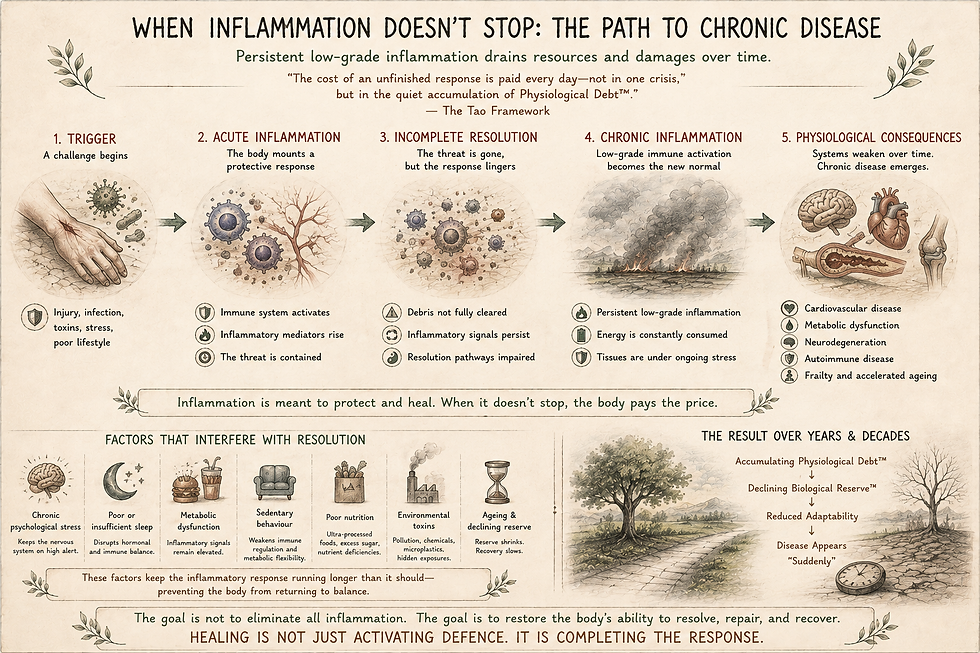
The important word, however, is temporary. An inflammatory response is useful because it solves a problem. Once the threat has been contained and damaged tissue has been cleared, biology must change direction. Defence must give way to repair.

Healing Requires More Than Turning Inflammation Down
We often imagine the end of inflammation as a passive process. The threat disappears, inflammatory signals gradually fade, and the body returns to normal. Healing is more sophisticated than that. The immune system must transition from a state organised around defence toward one organised around clearance, rebuilding, and restoration. Cells that were useful during the initial response must change their behaviour or leave the tissue. Damaged material must be removed. Signals promoting continued inflammation must decline while signals supporting repair become more prominent.
In other words, the end of inflammation is not simply the absence of inflammation.
It is another biological programme. This distinction matters because a response can begin appropriately and still fail to complete successfully.
A fire alarm that sounds during a real fire is useful. A fire alarm that continues ringing for weeks after the fire has been extinguished becomes a problem of its own. Human physiology faces the same challenge.
When the Immune System Does Not Fully Stand Down
Chronic inflammation is very different from the dramatic inflammation of an infected wound or an acute illness. It is often quieter, more diffuse, and far less obvious. Rather than producing a single intense response, the immune system can remain in a state of persistent low-level activity.
The earlier Tao Papers have already explored several conditions that can contribute to this biological environment: disrupted sleep, chronic psychological stress, metabolic dysfunction, physical inactivity, persistent physiological strain, and declining biological reserve. The important progression here is understanding what those pressures may mean for immune regulation.
If inflammatory signalling is repeatedly activated, if the original stimulus persists, or if the mechanisms responsible for resolution become less effective, the body may never complete the transition from defence toward repair. This creates a biological contradiction. The immune system continues receiving instructions to remain vigilant while tissues simultaneously require rebuilding. Energy continues to be spent on defence even though long-term maintenance also requires resources. The body is therefore not simply dealing with “too much inflammation.” It is dealing with an inflammatory response that has not successfully completed its cycle.
Inflammation Has an Energetic Cost
This also connects inflammation to Energy Economics™. Immune activity is metabolically expensive. Producing immune cells, synthesising signalling molecules, changing tissue behaviour, generating fever, repairing damaged structures, and replacing injured cells all require energy.
During an acute illness, this investment makes biological sense because eliminating the threat is the immediate priority. Persistent inflammatory activity is different. Over time, this persistent expenditure can become one contributor to Physiological Debt™.”If immune activation continues for months or years, some of the body’s biological budget remains committed to defence. Resources that might otherwise support muscle maintenance, tissue repair, cognitive performance, metabolic flexibility, or other long-term functions are competing with an immune system that has not fully returned to baseline.
Paper No. 4 introduced the idea that the body must continually decide where its energy is spent, and that persistent inflammation represents one of those ongoing biological expenditures. This paper takes that idea one step further. The goal is not merely to spend less energy on inflammation. It is to understand why the inflammatory response remains active in the first place.
The Difference Between Suppression and Resolution
This leads to an important distinction in how we think about treatment. There are circumstances in medicine where suppressing inflammation is essential. Severe inflammatory diseases can damage tissue, threaten organs, and require powerful anti-inflammatory or immune-modulating therapies. Nothing about a systems-based approach changes that. But suppression and resolution are not identical ideas.
Suppressing inflammation asks: How can we reduce the inflammatory response?
A systems perspective also asks: Why is the body continuing to generate the response?
Sometimes the answer is obvious, such as persistent infection, autoimmune disease, tissue injury, or another recognised medical condition. In other situations, the picture may involve multiple interacting influences across metabolism, sleep, stress physiology, physical activity, body composition, environmental exposure, and immune regulation.
This is where systems biology becomes particularly useful. The Tao Framework deliberately views physiology as an interconnected system rather than a series of isolated organs.
The immune system does not operate independently from metabolism, the nervous system, endocrine signalling, the gut, sleep, or cellular energy production. Inflammation therefore cannot always be understood by examining immunity alone.
A Clinical Perspective
In clinical practice, inflammation is sometimes discussed as though it were a diagnosis in itself. A patient is told they are “inflamed,” and the obvious next step appears to be finding ways to reduce inflammation.
I find a different question more useful: What is asking the immune system to remain active?
That question changes the clinical investigation. Is there a persistent inflammatory disease that requires diagnosis? Is metabolic dysfunction contributing to inflammatory signalling? Is sleep disruption interfering with recovery? Is an unresolved infection present? Is tissue injury continuing? Are several physiological pressures reinforcing one another?
Appropriate medical evaluation remains essential because persistent inflammation can reflect significant disease. The goal is not to interpret every symptom through the lens of inflammation, nor to assume that lifestyle changes can replace necessary treatment.
The broader lesson is that the inflammatory response has a purpose. Understanding that purpose can sometimes tell us more than simply measuring its intensity.
The Tao Perspective
The Tao Framework views health as the capacity to adapt, repair, and recover.
Inflammation illustrates all three. The body must adapt rapidly when danger appears. It must defend itself effectively while the threat remains. It must then recognise when defence is no longer required and redirect its resources toward rebuilding. Health therefore depends not on eliminating inflammation, but on preserving the full arc of the inflammatory response: Activation when needed. Defence while necessary. Resolution when the work is complete. Repair once the threat has passed.
This principle extends far beyond immunity. Healthy physiology is filled with processes that must know both how to activate and how to stop. Stress responses must subside. Blood glucose must rise and fall. Heart rate must accelerate and recover. Muscles must experience load and then rebuild.
Perhaps one of the defining features of biological health is not simply the ability to respond.
It is the ability to complete the response.
Clinical Reflection
Consider one question this week: Is your biology dealing with a current threat—or continuing to respond to one that should already have passed?
The answer will not provide a diagnosis. It may, however, offer a different way of thinking about inflammation: not simply as something to fight, but as a biological process whose success depends on knowing when its work is finished.
Continue Exploring the Tao Framework
If you enjoyed this paper, you may also find these essays helpful:
Why health is better understood as a dynamic biological process than simply the absence of disease.
Why resilience may be one of the earliest indicators of declining health.
The hidden physiological capacity that determines how well we recover, adapt, and age.
Why every biological system competes for energy—and why how the body allocates energy matters as much as how much it produces.
Why normal blood tests do not always mean optimal health.
What Functional Medicine Looks For When Conventional Tests Are Normal Understanding how symptoms can arise from declining physiological function long before disease develops.


Comments