
Disease vs Function: Two Different Ways to Understand Health

Updated: Jul 22
Modern medicine has become remarkably effective at identifying disease. A routine blood panel can detect anaemia, diabetes, thyroid disorders, kidney dysfunction, and a host of other abnormalities long before they become life-threatening. Advanced imaging technologies can reveal structural changes measured in millimetres, while increasingly sophisticated laboratory techniques allow physicians to identify biological disturbances that would have gone unnoticed only a generation ago. These advances represent one of the great achievements of modern healthcare, saving countless lives and transforming conditions that were once fatal into manageable chronic illnesses.
Yet alongside these successes exists a growing paradox. Every year, millions of people undergo medical investigations because they do not feel well. They are fatigued despite adequate sleep. They struggle with brain fog, declining concentration, poor recovery, digestive symptoms, or a persistent sense that their energy and resilience are not what they once were. Their physicians order appropriate tests, the results return reassuringly normal, and serious pathology is excluded. Despite this reassurance, the symptoms remain.
For many individuals, this experience creates an uncomfortable tension. Normal results are reassuring, but they do little to explain why everyday life feels increasingly difficult. The conclusion often becomes either that
nothing is wrong or that the symptoms are somehow insignificant. Neither explanation is particularly satisfying to someone who feels their health has changed in ways that are impossible to ignore.
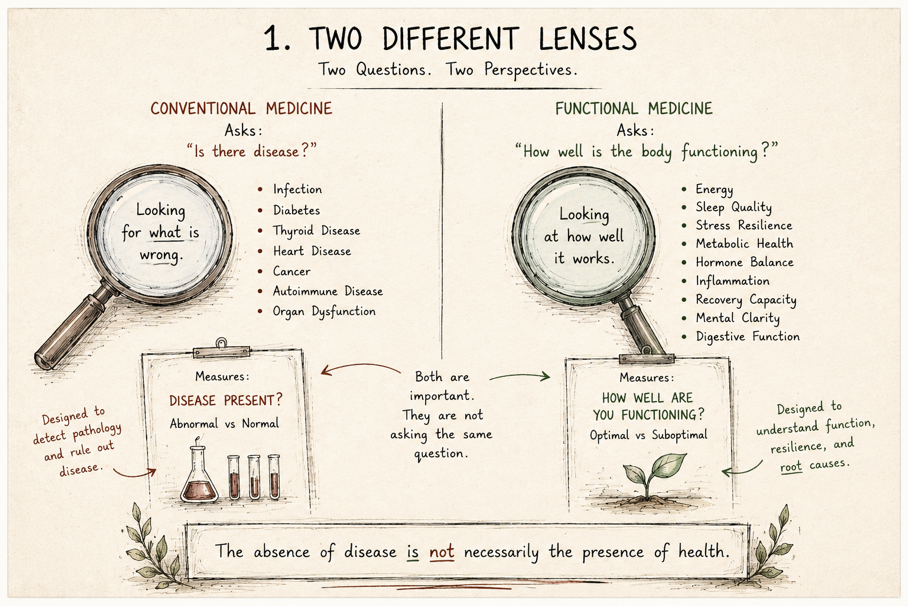
The difficulty may lie in the way we define health itself. Modern medicine is exceptionally skilled at identifying disease, but disease and health are not necessarily opposite ends of the same spectrum. Between vibrant wellbeing and diagnosable illness lies a broad territory in which physiological systems continue to function yet no longer function particularly well. An individual may not meet the criteria for a medical diagnosis while still experiencing a meaningful decline in energy, recovery, cognitive performance, sleep quality, or overall resilience.
It is within this territory that functional medicine tends to focus its attention.
Rather than asking only whether disease is present, functional medicine asks a different question: how effectively is the body functioning? This distinction may appear subtle, but it fundamentally changes the conversation. Instead of viewing symptoms as isolated problems, functional medicine views them as signals emerging from interconnected biological systems. Fatigue, poor sleep, digestive discomfort, declining performance, and brain fog are often not separate problems. They may be different expressions of the same underlying loss of function.

One of the challenges in modern healthcare is that we have become highly skilled at measuring pathology but less adept at measuring vitality. Most people are not seeking a laboratory report that confirms they are free from disease. They are seeking stable energy, mental clarity, restorative sleep, emotional resilience, and the capacity to engage fully with their lives. These qualities matter profoundly, yet they are not always captured by conventional investigations.
In my experience, many of the individuals who continue to struggle despite normal tests are experiencing challenges in one or more of five broad domains of function: recovery, regulation, metabolism, inflammation, and connection. These domains are not diagnoses, nor are they intended to replace conventional medical evaluation. Rather, they provide a framework for understanding how health can gradually decline even in the absence of identifiable disease.
Recovery is perhaps the most obvious, yet it is frequently misunderstood. Most people equate recovery with sleep, but recovery encompasses far more than the number of hours spent in bed. It reflects the body's ability to restore itself after physical exertion, cognitive effort, emotional strain, and the countless demands of everyday life. A person with impaired recovery may sleep for eight hours and still wake feeling unrefreshed. They may rely increasingly on caffeine to function, find that weekends no longer restore their energy, or discover that even holidays fail to produce the sense of renewal they once did. The issue is not merely fatigue; it is a diminished capacity to return to baseline after challenge.
Closely related to recovery is regulation, a domain largely governed by the nervous system. A healthy nervous system is flexible. It can mobilize resources when circumstances demand action and return to a state of rest once the challenge has passed. Increasingly, however, modern life subjects individuals to a continuous stream of low-grade stressors. Professional pressures, financial concerns, caregiving responsibilities, information overload, and constant digital connectivity create a physiological environment in which recovery becomes increasingly difficult. The resulting symptoms are not always dramatic. More often they appear as irritability, poor sleep, heightened reactivity, difficulty concentrating, or the sense that even minor setbacks require disproportionate effort to manage.
The third domain, metabolism, concerns the body's ability to produce and utilize energy efficiently. Although metabolic health is often discussed in the context of weight gain or diabetes, its influence extends far beyond either condition. Every thought, heartbeat, muscle contraction, and repair process depends upon the effective production of energy. When metabolic function begins to decline, symptoms often emerge long before disease develops. Energy becomes inconsistent, concentration fluctuates, cravings increase, and performance increasingly depends upon caffeine, sugar, or determination. Many people assume these changes are an inevitable consequence of aging, yet they frequently reflect alterations in physiology that deserve closer attention.

Inflammation represents a fourth and equally important domain. Inflammation is not inherently harmful; indeed, it is essential for healing and survival. Problems arise when inflammatory processes remain active long after they are needed. Chronic low-grade inflammation has been associated with fatigue, brain fog, poor recovery, mood disturbances, and numerous chronic health conditions. Unlike acute illness, however, it rarely announces itself dramatically. Instead, it functions as a persistent background burden, subtly diminishing resilience over months or years. Individuals may notice this as aching joints, slower recovery, digestive symptoms, reduced exercise tolerance, or the feeling that their body seems older than its chronological age.
The final domain is perhaps the least discussed in healthcare, yet it may be among the most important. Human beings evolved within families, communities, and social networks. Increasing evidence suggests that connection influences immunity, cardiovascular health, stress resilience, recovery, and longevity. Despite this, modern life often pushes people toward isolation. Long working hours, geographic mobility, digital communication, and increasingly fragmented communities can gradually erode meaningful social connection without individuals fully recognizing what has been lost. The result is not merely loneliness. It may also contribute to emotional exhaustion, diminished resilience, reduced motivation, and poorer overall health.
What makes these five domains particularly useful is that none can be fully understood through laboratory testing alone. Blood tests remain essential for identifying disease and excluding serious pathology, but they are less effective at determining whether an individual feels restored, resilient, adaptable, connected, or capable of meeting the demands of life. These qualities are often experienced long before they can be measured.
For this reason, it may be worth asking questions that never appear on a laboratory report. Do you wake feeling restored most mornings? Is your energy stable throughout the day? Do you recover effectively from physical and emotional stress? Is your concentration as sharp as it once was? Do you feel connected to the people around you and resilient when life becomes demanding? Although these questions lack the precision of a blood test, they often provide valuable insight into overall wellbeing.
Perhaps the most important contribution of functional medicine is not a particular test, supplement, or treatment protocol. It is a broader way of thinking about health. Rather than focusing exclusively on disease, it asks how effectively the body's systems are functioning and whether they retain the capacity to adapt, recover, and remain resilient in the face of life's demands. Most people are not asking whether they have a disease. They are asking why they no longer feel like themselves.
The answer rarely lies within a single organ, diagnosis, or laboratory value. More often, it emerges from understanding how the body's systems interact and whether they continue to function as effectively as they were designed to. Health, after all, is not simply the absence of pathology. It is the presence of function.


Comments