
Adaptive Capacity™

Updated: Sep 10
The Tao Papers
Paper No. 2
Why Adaptation Matters More Than Diagnosis
(Estimated reading time: 6 minutes)
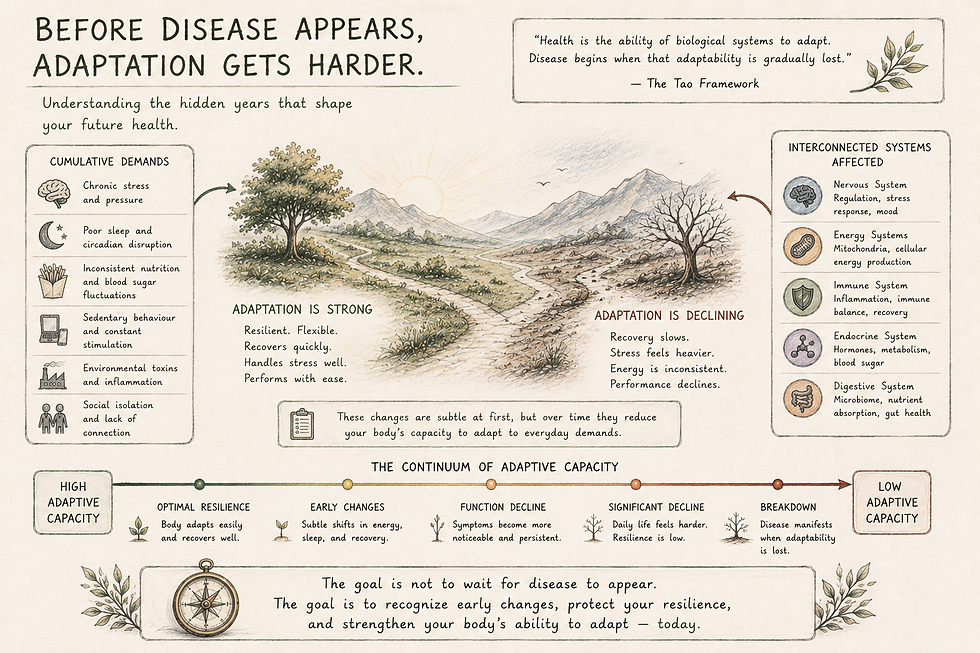
“Health is not the absence of disease. It is the ability of biological systems to adapt. Disease begins when that adaptability is gradually lost.”— The Tao Framework
Health Is the Ability to Adapt
Physiologists describe this ability as adaptive capacity—the remarkable capacity of biological systems to respond to challenge, recover efficiently, and restore balance. Within systems biology, functional medicine, and modern resilience science, adaptive capacity is increasingly recognised as one of the most meaningful indicators of long-term health, healthy ageing, and human performance. Rather than asking only whether disease is present, this perspective asks a different question: How well is the body adapting?

Modern medicine has transformed our ability to diagnose disease. Blood tests identify anaemia, diabetes, thyroid disorders, kidney disease, and countless other conditions with remarkable accuracy. Imaging technologies detect abnormalities that previous generations could neither see nor treat. These advances have saved millions of lives and remain among medicine’s greatest achievements.
Yet many people seek medical advice for a different reason. They are not asking whether they have a serious disease. They are asking why they no longer feel like themselves. Persistent fatigue, brain fog, declining exercise tolerance, disrupted sleep, reduced mental clarity, and increasing difficulty coping with chronic stress are among the most common reasons people search for answers, even when conventional investigations appear normal.
Perhaps this reflects a limitation not of medicine itself, but of how health is commonly understood. We often imagine health as a stable state that exists until disease interrupts it. Living systems do not work that way. Every second of every day, the human body adapts to an ever-changing environment. The nervous system, immune system, endocrine system, metabolism, and circadian rhythm continuously communicate to maintain internal balance despite changing demands. Heart rate accelerates during physical activity before slowing again at rest. Hormones adjust after every meal. The immune system distinguishes between harmless and harmful organisms, while the brain consolidates memories and repairs tissues during sleep.
Health, therefore, is not static. It is the remarkable ability to change appropriately. A healthy body is not one that never encounters stress, but one that regulates its stress physiology, recovers efficiently, and restores equilibrium. Adaptation is not simply one characteristic of health; it is one of the defining characteristics of life itself.
When Adaptation Begins to Decline
The importance of adaptive capacity becomes clearer over time. Most chronic disease does not appear suddenly. Long before disease becomes visible, resilience often begins to diminish. Recovery after a poor night’s sleep becomes slower. A demanding week at work requires an entire weekend to overcome. Minor illnesses linger longer than they once did, while physical energy, cognitive performance, and metabolic health gradually become less reliable despite maintaining the same routines.

These changes rarely occur because the body has suddenly failed. More often, they reflect a gradual decline in its ability to adapt to the cumulative demands placed upon it. The same principle can be observed in other complex systems. Hospitals rarely collapse because of one busy afternoon in the emergency department. Communities rarely fail because of a single storm or drought. Long before visible failure occurs, resources become stretched, recovery slows, and the capacity to respond to the next challenge steadily narrows. The system continues to function, but it does so with progressively less reserve.
Human biology follows remarkably similar principles. This perspective also explains why many people experience declining wellbeing despite normal blood tests. Conventional investigations are designed to identify disease, and they do so exceptionally well. They are far less capable of measuring resilience. A blood test may confirm that the thyroid is functioning normally, but it cannot determine how quickly someone recovers after emotional stress, whether the autonomic nervous system is well regulated, or how effectively the body’s biological systems continue adapting to everyday life.
Adaptive capacity occupies the space between health and disease. It reflects how effectively the nervous system, immune system, endocrine system, metabolism, and mitochondrial energy production continue to work together in response to challenge. When these biological networks communicate efficiently, recovery is rapid and resilience remains high. When communication becomes less coordinated, adaptation becomes increasingly costly, often long before disease develops.
Recovery: The Window into Resilience
One of the most useful ways to observe adaptive capacity is not by measuring performance, but by paying attention to recovery. Many people continue performing at a remarkably high level long after resilience has begun to decline. They still meet deadlines, care for their families, and fulfil their responsibilities because the body is remarkably good at compensating. Stress physiology allows performance to continue, but chronic compensation eventually carries a biological cost.
Recovery tells a different story.
How long does it take to recover after a demanding week? Do you wake feeling refreshed after a full night’s sleep? How quickly do you regain your energy after exercise or illness? Has your tolerance for stress changed over the past five years?
These questions may appear deceptively simple, yet they often reveal subtle changes in recovery, burnout, fatigue, and resilience long before conventional markers become abnormal.
A Clinical Perspective
One of the questions that often provides the greatest insight in clinical practice is not simply whether someone feels tired. Fatigue has many causes and, by itself, rarely tells the whole story. A more revealing question is:
What no longer feels as easy as it did five years ago?
The answers are rarely dramatic. People describe taking longer to recover after travel, finding it harder to concentrate late in the afternoon, becoming more susceptible to minor infections, or needing several days to recover from activities they once enjoyed. None of these experiences establishes a diagnosis, but together they often suggest that adaptive capacity is beginning to change.
From a functional medicine perspective, these subtle changes often represent early disturbances in biological function rather than established disease. The objective is not simply to identify pathology, but to understand why resilience is changing. That requires looking beyond individual organs and considering how sleep, metabolic health, nervous system regulation, immune function, recovery, and lifestyle interact as an integrated biological system.
These observations are valuable because changes in recovery often precede measurable disease. They offer an opportunity to recognise declining physiological resilience while there is still time to preserve it, rather than waiting until pathology becomes obvious.
The Tao Perspective
Modern medicine has transformed our ability to diagnose disease, and few advances have had a greater impact on human health. Yet perhaps the next frontier is not simply detecting disease earlier, but recognising the gradual loss of adaptability that often precedes it.
From the perspective of the Tao Framework, health is not defined solely by what appears on a laboratory report. It reflects the body’s ability to regulate the nervous system, maintain metabolic health, recover from chronic stress, preserve mitochondrial function, and continually adapt to an ever-changing environment. Disease is important to diagnose. Adaptability is equally important to preserve.
This is the essence of functional medicine and root cause medicine. The goal is not simply to treat illness after it appears, but to understand the biological processes that maintain resilience long before disease develops. Preserving adaptive capacity may be one of the most effective forms of chronic disease prevention available to us.
Life will always place demands upon us. The more meaningful question is not whether stress can be avoided, but whether our biology retains the capacity to adapt when it inevitably arrives.
Clinical Reflection
One question worth considering this week:
What takes longer for you to recover today than it did five years ago?
The answer is unlikely to provide a diagnosis. It may, however, offer one of the earliest clues that your adaptive capacity is changing—and that your health deserves attention long before disease becomes apparent.
Continue Exploring the Tao Framework
If you found this paper helpful, you may also enjoy:


Comments