
Why the Body Prioritises Defence Over Repair

Updated: Sep 10
Paper No. 6
How the biology of survival can quietly postpone sleep, digestion, healing, and long-term health
(Estimated reading time: 6 minutes)
“The body does not neglect repair because it has forgotten how to heal. It postpones repair when it believes survival requires its resources elsewhere.” — The Tao Framework
Why Can Rest Fail to Feel Restorative?
Most of us have experienced periods when rest seems to stop working. We sleep, yet wake feeling unrefreshed. We take time away from work, yet return without feeling restored. We sit quietly, but remain internally tense. Digestion becomes unsettled, concentration less reliable, and minor physical complaints take longer to resolve. It is tempting to conclude that we simply need more rest.
Sometimes we do. But physical inactivity and biological recovery are not the same thing. A person can be lying in bed while the nervous system remains vigilant, stress hormones continue mobilising energy, and the brain behaves as though an important threat has not yet passed. The body is not organised around comfort. It is organised around survival.
When danger is perceived or resources become limited, physiology must decide what matters now and what can wait. Immediate defence takes priority. Digestion, tissue repair, deep sleep, growth, reproduction, and long-term maintenance may temporarily receive fewer resources. This is not a malfunction. It is one of the oldest and most intelligent strategies in human biology. The difficulty begins when a temporary survival response becomes a permanent biological state.
Survival Creates a Biological Hierarchy
Every moment, the body performs thousands of tasks requiring energy and raw materials. Cells repair damaged proteins. The immune system surveys for infection. The intestinal lining renews itself. Muscles rebuild after activity. The brain consolidates memory. Hormones regulate metabolism, sleep, growth, and reproduction.
All of these processes matter, but they are not equally urgent.
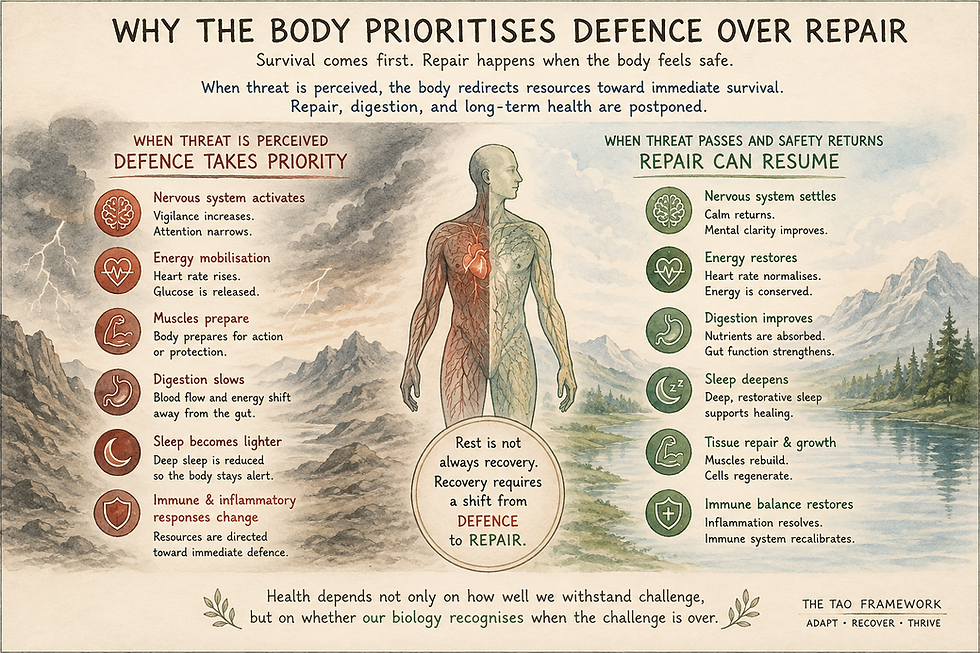
When the brain perceives immediate danger, the biological hierarchy changes. Heart rate and blood pressure may rise. Glucose is released into the bloodstream. Attention narrows. Muscles prepare for action. Blood flow and digestive activity shift. Sleep becomes lighter because deep unconsciousness is less useful when danger may still be present.
Meanwhile, tasks that can safely wait are postponed. The body can delay some repair. It can reduce digestive and reproductive activity. It can sacrifice a degree of long-term efficiency in exchange for greater readiness now. This trade-off helped our ancestors survive infection, injury, famine, conflict, and environmental extremes. The survival response is therefore not the enemy of health. It is an essential expression of adaptive capacity. The more important question is whether the body can stand down once the challenge has passed.
Stress Changes What the Body Believes Is Urgent
Stress is often described as an emotional experience. Biologically, it is a change in priorities. When the brain detects threat, the sympathetic nervous system and stress-response pathways prepare the body for action. Adrenaline increases alertness and cardiovascular readiness. Cortisol helps sustain the response by mobilising glucose and making energy available to tissues that may need it.
In the short term, this is remarkably effective. During an emergency, there is little advantage in devoting maximum resources to digestion, deep sleep, tissue rebuilding, or reproduction. The body needs fuel, attention, circulation, and rapid decision-making. Immediate survival matters more than long-term optimisation.
Modern threats, however, often have no clear endpoint. A demanding inbox cannot be escaped by running. Financial insecurity cannot be resolved through a brief increase in blood glucose. Workplace conflict, caregiving pressure, loneliness, uncertainty, digital stimulation, and poor sleep may continue for months or years. The stress response remains useful, but its duration becomes costly. What evolved as a brief reallocation of resources can become a chronic biological budget.

Defence and Repair Must Share the Same Resources
The body does not completely stop repairing itself during periods of stress. Defence and restoration continue simultaneously. But when resources and physiological capacity are constrained, they enter a form of biological energy competition. But when resources and physiological capacity are constrained, they compete.
An infection illustrates this clearly. Immune defence requires substantial energy. People often lose their appetite, become tired, withdraw socially, and reduce activity. These changes help redirect resources toward fighting the infection. Once the threat resolves, appetite returns, inflammation subsides, energy improves, and repair becomes more prominent.
Chronic psychological or physiological stress can create a less visible version of the same trade-off. The body continues functioning, but resources are repeatedly directed toward vigilance and mobilisation. Digestion becomes less reliable. Sleep loses depth or continuity. Glucose regulation becomes less stable. Muscle tension persists. Inflammatory signalling may remain more active than necessary.
Each change may be modest. The importance lies in its persistence. A stressful week rarely destroys health. The body is designed to absorb temporary disruption. But when defence repeatedly takes priority over restoration, unfinished biological work begins to accumulate. This is one pathway through which Physiological Debt™ develops.
Why Rest Is Not Always Recovery
This distinction explains why simply stopping activity does not always restore the body.
Rest describes what a person is doing. Recovery describes what their biology is able to accomplish. Someone may spend an evening on the sofa while remaining mentally preoccupied and physiologically alert. They may sleep for eight hours but experience fragmented sleep. They may take a holiday while remaining connected to the same demands that kept their nervous system activated at home.
The body has been removed from work, but it has not necessarily received a convincing signal that the threat has passed. Recovery requires a shift in biological state. Stress activation must decline. Digestion must regain support. Sleep must deepen. Muscle tension must ease. Immune and hormonal systems must be given an opportunity to recalibrate.
This is why restorative experiences are not always passive. A walk outdoors, rhythmic movement, a supportive conversation, time with trusted people, or a predictable evening routine may promote recovery more effectively than hours of distracted inactivity. Their value lies not merely in using less energy, but in changing the biological message. They tell the body that immediate defence is no longer the only priority.

Health Depends on Returning
Health is an active biological process, not a permanently calm state. A healthy nervous system can become highly activated during challenge. A healthy immune system can generate powerful inflammation during infection. A healthy metabolism can rapidly mobilise fuel during exercise or fasting.
The defining feature of health is not the absence of activation. It is the ability to return.
After exercise, heart rate slows and tissues begin rebuilding. After infection, inflammatory pathways resolve. After a difficult event, stress hormones fall and normal priorities resume. Digestion, sleep, repair, connection, and long-term maintenance regain their place. Problems arise when the return journey remains incomplete.
A person may continue functioning and meeting responsibilities, but their baseline has shifted. They remain slightly more vigilant, sleep less deeply, digest less reliably, and recover more slowly. Each new challenge begins before the body has fully completed its recovery from the last one. Biological Reserve™ is then used not only to meet unusual demands, but to sustain ordinary life.
A Clinical Perspective
In clinical practice, prolonged defence often appears through patterns rather than a single diagnostic marker. Patients may describe being exhausted but unable to switch off. Their digestive symptoms worsen during demanding periods. Sleep becomes lighter, appetite changes, and pain or muscle tension becomes more noticeable. Exercise may help at one intensity but become depleting when added to an already overloaded system. These symptoms have many possible causes and should never be attributed to stress without appropriate medical assessment. This is also where a functional medicine perspective can help explore declining physiological function even when conventional tests remain normal. Yet they invite an important question:
What is the body continuing to defend against?
The answer may involve psychological pressure, disrupted sleep, unresolved illness, chronic inflammation, unstable metabolism, excessive training, environmental conditions, or several interacting factors.
The clinical goal is not to eliminate every demand from life. Challenge can build resilience when followed by sufficient recovery. The goal is to understand why the body is failing to return to a state in which repair can again receive priority.
The Tao Perspective
The Tao Framework views recovery not simply as the absence of work, but as a biological transition from defence toward restoration. The body cannot be commanded to heal through willpower alone. It responds to information: light and darkness, movement and stillness, nourishment, rhythm, relationships, safety, and the presence or absence of threat.
Health therefore depends not only on how well we withstand challenge, but on whether our biology recognises when the challenge is over. The purpose of prevention is not to create a life without stress. It is to preserve the ability to mobilise when necessary, recover when possible, and prevent temporary survival priorities from becoming permanent biological conditions.
Clinical Reflection
Consider one question this week: When you stop working, does your body also stop defending?
The answer may help explain why rest sometimes restores you—and why, at other times, recovery remains unfinished.
Continue Exploring the Tao Framework
If you enjoyed this paper, you may also find these essays helpful:
Why health is better understood as a dynamic biological process than simply the absence of disease.
Why resilience may be one of the earliest indicators of declining health.
The hidden physiological capacity that determines how well we recover, adapt, and age.
Why every biological system competes for energy—and why how the body allocates energy matters as much as how much it produces.
Why normal blood tests do not always mean optimal health.
What Functional Medicine Looks For When Conventional Tests Are Normal Understanding how symptoms can arise from declining physiological function long before disease develops.


Comments