
What Happens When Circadian Rhythms Drift

Updated: 3 days ago
Paper No. 11
Why the body can keep functioning even when its internal clocks are no longer working together
(Estimated reading time: 7 minutes)
“The body can adapt to disruption. The problem begins when disruption becomes the rhyth" — The Tao Framework
What Happens When Biological Time and Clock Time Disagree?
Most of us have experienced jet lag. We arrive somewhere new, change the time on our phone and immediately begin living according to the local clock. Breakfast may occur when the body expects sleep, we may lie awake at midnight despite being exhausted, and hunger or alertness can appear at peculiar times.
Nothing is necessarily wrong with any individual organ. The problem is that the time displayed on the wall has changed much faster than the time being kept inside the body.
In the previous Tao Paper, we explored the circadian system: the network of biological clocks that helps organise sleep, alertness, metabolism, hormonal signalling, immune activity and repair across approximately twenty-four hours. The body does not perform every task equally at every moment; instead, it changes its physiological priorities in an organised way.
Circadian drift introduces the other side of that story. The biological clocks do not necessarily stop working when our schedules become irregular. More often, they continue functioning while becoming less aligned with one another and with the environment around us.

Circadian Disruption Is Often a Problem of Misalignment
The word disruption can suggest that something has been damaged or switched off. Circadian misalignment is often subtler. The brain may receive one timing signal from light while behaviour provides another. Sleep may occur when the circadian system is still promoting wakefulness, while food or activity may arrive during periods the body has historically associated with rest.
Jet lag makes this mismatch obvious because the change occurs suddenly. Shift work can create a more persistent version, particularly when people alternate between daytime and nighttime schedules. Smaller mismatches can occur through irregular sleep, substantial differences between weekday and weekend schedules, limited daytime light followed by substantial evening light, or highly variable patterns of activity.
Occasional disruption is something human physiology can usually accommodate. Our biology evolved with considerable flexibility, and a perfectly repetitive schedule is neither necessary nor realistic. The more important question is what happens when misalignment becomes frequent enough that the body is repeatedly required to compensate for it.
The Body Has More Than One Clock
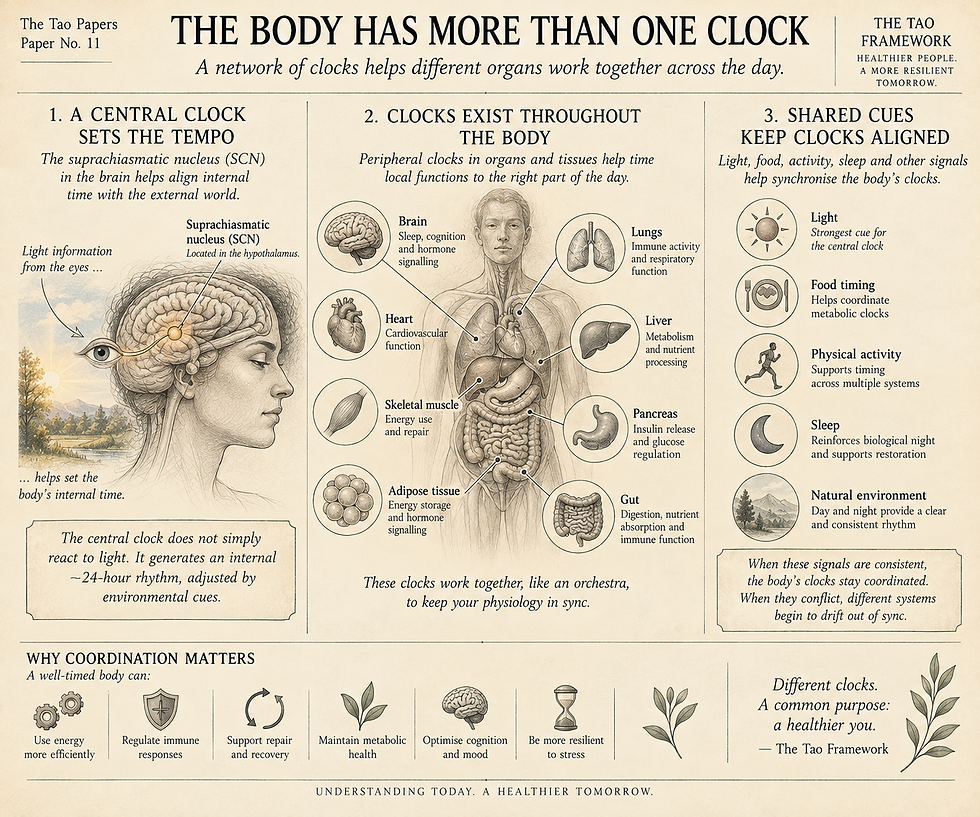
The body does not contain a single biological clock. The suprachiasmatic nucleus in the brain plays a central coordinating role, but clock mechanisms also operate throughout tissues including the liver, pancreas, skeletal muscle and adipose tissue.
These clocks do not all respond equally to the same signals. Light is particularly important for the central circadian clock, while food timing, physical activity and sleep provide additional timing information to peripheral tissues.
Under relatively stable conditions, these signals tend to reinforce one another. Daylight, wakefulness, activity and eating generally cluster around biological daytime, while darkness, fasting and sleep occur more prominently during biological night. Modern life, however, allows these signals to become separated. We can wake before sunrise, remain indoors throughout much of the day, eat late at night, work under artificial illumination and sleep well into daylight.
None of these behaviours in isolation determines whether someone is healthy. The more relevant issue is the overall pattern. When different biological systems repeatedly receive conflicting information about time, maintaining coordination becomes more difficult.
Sleep Is Often Where We Notice the Drift First
Sleep provides one of the most recognisable manifestations of circadian misalignment because sleep pressure and circadian timing are separate but interacting processes. As Paper 10 explained, it is possible to be profoundly tired without being biologically ready to sleep.
The reverse can also occur. An alarm can force someone awake while their circadian system is still strongly promoting sleep. This helps explain why sleep cannot be understood entirely by duration. Someone may technically obtain a reasonable number of hours yet still struggle because the timing of those hours continually shifts.
Weekend schedules provide a familiar example. A person who wakes early throughout the working week but progressively delays sleep and waking over the weekend may find Sunday night unexpectedly difficult. The issue is not that everyone must sleep at precisely the same time every day, but that circadian systems use recurring environmental patterns to organise physiology. Regularity gives biology something predictable to work with.
Metabolism Also Keeps Time
Circadian drift becomes even more interesting when we move beyond sleep. Metabolism is not constant across twenty-four hours. Glucose regulation, insulin sensitivity, digestive activity, appetite signalling and energy utilisation all vary across the biological day.
This means that the metabolic response to a meal depends not only on what is eaten but partly on the physiological context in which it arrives. That observation should not become a rigid rule declaring that everyone must eat within identical hours. Human metabolism is flexible, and individual circumstances vary considerably.
The more useful principle is that metabolism operates within time. When feeding patterns repeatedly extend into periods normally associated with biological night, peripheral metabolic clocks may receive timing information that differs from signals arriving through the central circadian system.
Temporary discrepancies can usually be accommodated. Persistent compensation, however, represents additional biological work.
Misalignment Creates Biological Work
Human physiology is remarkably capable of accommodating temporary disruption. We travel across time zones, stay awake with a sick child, work late to finish something important and occasionally celebrate well after midnight. The ability to adjust and subsequently recover is part of Adaptive Capacity™. Within the Tao Framework, health is understood partly through the ability to adapt, repair and recover rather than through the maintenance of perfect conditions.
Adaptation, however, is not free. When behaviour repeatedly conflicts with biological timing, physiology must compensate. Alertness may need to be maintained while the circadian system is promoting sleep. Sleep may be attempted while wake-promoting signals remain relatively strong. Metabolic tissues may process nutrients when their normal physiological programme is shifting toward other priorities.
This connects circadian disruption with Energy Economics™ and Physiological Debt™. The argument is not that an irregular evening suddenly causes disease. Rather, repeated demands can increase the work required to preserve normal function. When those demands repeatedly exceed opportunities for restoration, the biological cost may gradually accumulate.
Circadian misalignment can therefore be understood not simply as a sleep problem, but as another condition in which the body is repeatedly asked to adapt.
A Clinical Perspective
Circadian health is sometimes reduced to a collection of instructions: seek morning light, avoid screens, eat earlier and maintain a consistent bedtime. These recommendations may be useful, but the underlying physiology suggests a more informative clinical question:
How predictable is this person’s biological day?
When do they normally wake? When are they exposed to meaningful daylight? When do activity and meals occur? When does sleepiness naturally emerge? How dramatically does the schedule change between working days and days off?
The objective is not to impose a perfect routine, but to identify persistent mismatches between behaviour, environmental signals and biological timing. This perspective can be useful when someone reports unrefreshing sleep, difficulty waking, persistent late-night alertness, daytime fatigue or substantial fluctuations in energy. Circadian misalignment is certainly not the only explanation for these symptoms. Sleep disorders, medications, psychological distress, medical illness and other factors may contribute and deserve appropriate assessment.
Circadian timing is simply another dimension of physiology that can be missed when the clinical conversation focuses exclusively on how many hours someone sleeps.
The Tao Perspective
The Restoration module has followed a deliberate progression. Recovery is active biological work. Sleep provides one of the most important environments in which that work occurs. Circadian rhythms help organise when different biological priorities become prominent, while circadian misalignment demonstrates what happens when those processes become less coordinated.
This brings us back to a central principle of the Tao Framework: healthy systems are not defined by rigidity, but by their capacity to change and recover. Biological Reserve™ provides capacity to absorb temporary demands, Adaptive Capacity™ allows physiology to respond to changing circumstances, and recovery restores what those adaptations have spent. As Paper 8 established, removing a challenge creates the opportunity for restoration, but does not itself complete the work of recovery.
Circadian health follows the same principle. A healthy rhythm does not require an immaculate schedule, nor does occasional disruption represent biological failure. What matters is whether the system retains the capacity to return toward a coherent rhythm once the disruption has passed.
Resilience is not the ability to avoid disruption. It is the ability to experience disruption without allowing disruption to become the new biological baseline.

Clinical Reflection
Rather than asking whether your daily schedule is perfect, it may be more useful to consider whether your body has a rhythm it can reliably return to. Occasional late nights, travel and changing demands are part of ordinary life, and healthy physiology is designed to accommodate them.
The greater challenge arises when irregularity itself becomes the pattern, leaving sleep, light exposure, activity and metabolism repeatedly operating according to different schedules. At that point, the important question is no longer whether yesterday was unusual, but whether the body still receives a sufficiently clear answer to one of biology’s most fundamental questions: What time is it?
Continue Exploring the Tao Framework
If you enjoyed this paper, you may also find these essays helpful:
How the biology of survival can quietly postpone sleep, digestion, healing, and long-term health
Why health is better understood as a dynamic biological process than simply the absence of disease.
Why resilience may be one of the earliest indicators of declining health.
The hidden physiological capacity that determines how well we recover, adapt, and age.
Why every biological system competes for energy—and why how the body allocates energy matters as much as how much it produces.
Why chronic disease often begins long before symptoms appear—and why the body can hide biological decline for years before it becomes visible
Why normal blood tests do not always mean optimal health.
What Functional Medicine Looks For When Conventional Tests Are Normal Understanding how symptoms can arise from declining physiological function long before disease develops.


Comments